I used to think “checking the news” was a normal thing. You checked. You got the gist. You moved on.
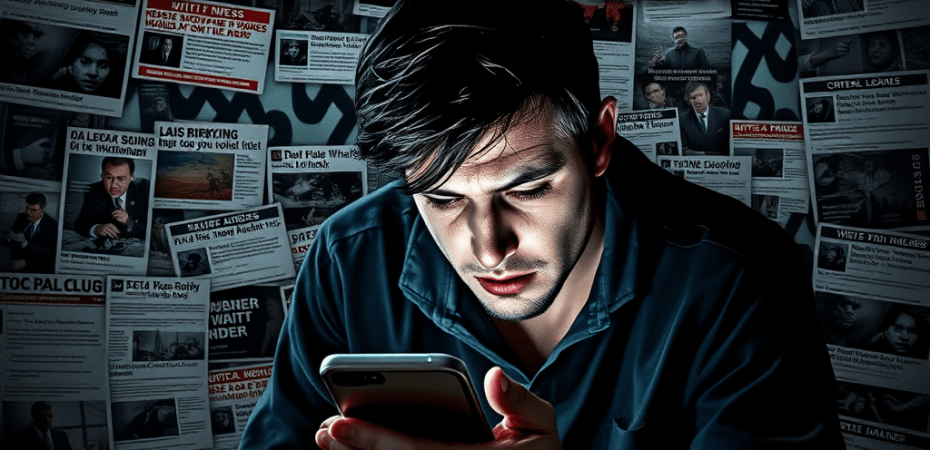
Doomscrolling is what happens when that same impulse gets dropped into an infinite feed. You go in for a quick look and come out later feeling tense, flat, or oddly wired. Not because you’re weak or dramatic, but because your brain is doing exactly what it’s designed to do when it senses threat: scan for information.
So what is doomscrolling, really?
It’s prolonged, repetitive scrolling through distressing or angry content (news, comments, reels, posts) even when it’s clearly not improving your mood.
The key part is the “even when”. You’re not making a calm choice. You’re stuck in a loop.
The psychology of “why can’t I stop?”
A few normal brain features combine into something that feels slightly unhinged in 2025.
1) Negativity bias
Your attention is drawn to potential danger more than neutral or positive information. That’s not a character flaw. It’s an old survival setting.
2) Uncertainty feels like a problem to solve
When you don’t know what will happen next, your brain often treats “more information” as the solution. So you refresh. You scroll. You look for the update that will make you feel settled. The problem is: feeds rarely provide a satisfying “done”.
3) Variable rewards (the slot machine effect)
Most posts are boring. Some are shocking. Occasionally one is genuinely useful. That unpredictability trains you to keep pulling the lever: “just one more”.
4) Social proof + outrage contagion
Humans are social learners. When everyone is panicking, dunking, arguing, or mourning in real time, your nervous system reads that as “pay attention”.
5) A tiny hit of agency
Scrolling can feel like doing something. Like you’re informed, responsible, across it. Sometimes it’s also a way to avoid the smaller, more immediate discomforts (dinner, emails, loneliness, decision-making). The feed gives you a ready-made emotional task.
None of this means you’re addicted to being miserable. It means you’re a person with a threat-detection system, holding a device engineered to keep you engaged.
Why it’s weird for millennials
This is the part that makes a lot of us go, wait… how did we end up here?
We grew up with “the internet”, but not with “the endless internet”.
Early online life had edges: a homepage, a forum thread, a page you reached the bottom of. Even the drama ended. You logged off because there was nowhere else to go.
Now the design is different. There is no bottom. There is no “I’m caught up.” You can’t finish.
We were trained to believe being online made us savvy.
Millennials got a lot of identity mileage out of being competent at the digital world. So it’s jarring to realise the digital world is competent at us.
There’s a particular millennial shame in thinking: “I know this is messing with my brain, and I still can’t put it down.” It clashes with the self-image of being media-literate, discerning, and not easily manipulated.
We learned ‘just checking’ as a coping strategy.
Many of us learned to self-soothe with information: Google it, research it, compare options, read reviews, see what people are saying. That works for solvable problems.
But doomscrolling is “research mode” applied to unsolvable, ongoing issues. It turns stress into a task that never completes.
We were handed a steady drip of global and economic instability.
Without turning this into a generational sob story: a lot of millennials have lived through repeated “once in a lifetime” events in a system that delivers those events straight to your pocket, with commentary, arguments, and hot takes attached.
The result is a nervous-system habit: stay alert, stay updated, be ready. Doomscrolling is that habit, industrialised.
How to know you’re doomscrolling (without overthinking it)
Try this quick check:
- You pick up your phone to do one thing and end up in news/social instead.
- You feel worse, but keep going.
- Your body feels activated: tight chest, clenched jaw, shallow breathing.
- You’re looking for “the update” that will make you feel calm.
If that’s you: congratulations, you’re not broken. You’re human.
A gentler way to stop (that doesn’t involve deleting everything)
Here are three options that work because they respect the psychology:
1) Add an ending
Feeds don’t end, so you create the end.
Examples: “5 posts then stop”, “3 minutes then stop”, “one article then stop”.
2) Add friction
Make the scroll slightly annoying.
Move the apps off your home screen. Log out. Turn notifications off. Use a web browser instead of the app. If it takes 10 extra seconds, your brain often chooses something else.
3) Don’t quit on peak stress
If you stop while your body is revved up, the scroll wins because your brain learns: “I only feel ok when I’m informed.”
So end with something that downshifts you for two minutes: a neutral video, a recipe, a short tidy, a shower, a voice note to a friend. You’re teaching your nervous system: “I can stop and still feel safe.”
The point
Doomscrolling isn’t “caring too much”. It’s caring with a tool that has no brakes.
And for millennials, it’s weird because we thought we were the ones driving.
 What did you learn?