
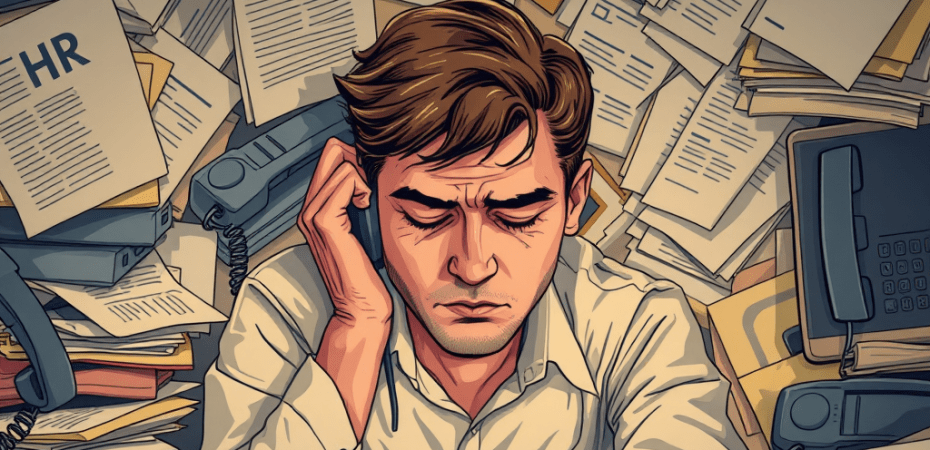
Lately I’ve noticed a pattern.
By the time I log off, my brain is done. Not because the work is complex on paper, but because of what I’ve held for other people all day.
I’m starting to see just how much emotional labour sits inside HR roles. It’s not in the job description, but it’s everywhere in the job.
What Emotional Labour Looks Like in HR
Here’s what it has looked like for me this month:
- Taking calls from managers who are frustrated, worried, or angry – and staying calm, neutral, and “helpful”.
- Sitting in the middle when two people can’t stand each other and both want validation.
- Being asked to confirm that someone is “doing the right thing” when they really want to be told there is no risk.
- Listening to long stories that are really about fear, guilt, or avoidance, then turning them into a neat “HR response”.
- Choosing my words carefully because everything I say might be screenshotted, escalated, or quoted back later.
None of that shows up in a case. It just lives in the body: in the tight shoulders, the headache, the mental fog at the end of the day.
“Can You Just Tell Me What To Do?”
One theme keeps coming up.
Managers say things like:
- “Can you tell me what to say in the meeting?”
- “Can you just write the email for me?”
- “What’s HR’s position on this?”
Sometimes that’s reasonable. They want to check process, risk, or fairness. That’s the job.
But sometimes, it’s not about process at all. It’s about discomfort.
What they really mean is:
“I don’t want to feel awkward, guilty, or like the bad guy. Can you remove that for me?”
HR can help with structure.
We can’t remove the feelings.
And when managers push that part onto HR, the emotional load doesn’t disappear. It just moves. Often onto the one person who already has a hundred people’s stress on their desk.
When Good Advice Doesn’t Fix Their Discomfort
Another draining pattern is when the advice is sound, but the manager still isn’t happy.
They might say:
- “Thanks, but I was hoping for more.”
- “That doesn’t really solve it.”
- “I’m still uncomfortable.”
What they often want is:
- A guarantee there will be no complaint.
- A guarantee the employee will agree.
- A script that makes a hard message feel easy.
No advice can do that.
When you’re in HR, it can feel like you’ve failed if they leave the conversation still uncomfortable. But lately I’ve realised: that discomfort belongs to them. It’s part of leading people.
My job is to make sure they are:
- Fair
- Clear
- Lawful
- Prepared
Not comfortable.
Boundaries: What HR Is (and Isn’t) Responsible For
I’m starting to draw some lines more clearly, at least for myself.
HR is responsible for:
- Explaining process and options.
- Highlighting risk and fairness.
- Offering language and structure.
- Encouraging early, informal conversations where possible.
- Supporting managers to think, not think for them.
HR is not responsible for:
- Guaranteeing outcomes.
- Fixing relationships that leaders won’t work on.
- Being the “bad guy” so others can stay liked.
- Absorbing unmanaged conflict and emotion for the whole organisation.
Writing that down helps. It stops the quiet drift into “If they’re unhappy, I must have done something wrong.”
Small Things I’m Doing to Protect My Energy
I don’t have a grand solution. But a few small changes are helping.
- Stock phrases: I keep a few lines ready, like
“I can help you think this through, but I can’t make the decision for you,” or
“That sounds uncomfortable, and it’s also an important part of your role as a leader.” - Reality checks: When I start to feel responsible for everything, I ask:
“Is this my job, or am I trying to rescue someone?” - Hard stop on the workday: I finish my notes, close the system, and don’t re-open “just to check something”.
- Naming it: Even just saying to myself, “This is emotional labour, that’s why I’m tired,” has helped. It validates the effort I can’t see on paper.
What I’ve Learned This Month
A few lessons I’m taking away:
- HR work is not just policies and processes; it’s constant emotional regulation.
- If managers are still uncomfortable after good advice, that doesn’t mean the advice was bad.
- Boundaries are not a lack of care. They are what make care sustainable.
- Naming emotional labour doesn’t magically reduce it, but it stops me gaslighting myself about why I’m exhausted.
I’m still tired. But at least now I know why. And that feels like a more honest place to start from.
 What did you learn?